

Why Fall 2026 is all about cozy, collected, slightly imperfect rooms that actually look like somebody lives there.
I think I’m officially done with rooms that look as though nobody is allowed to sit down. You know the ones: one beige sofa, two karate-chopped pillows, a coffee-table book nobody has ever opened, three carefully spaced objects on a shelf and a vase containing one sad branch that probably cost more than my first car payment. Everything is beautiful, everything is coordinated, and absolutely nothing suggests that a human being has ever come home tired, kicked off her shoes, left a mug of tea somewhere inappropriate and curled up under a blanket with the dog.
For years, this was apparently what we were all supposed to aspire to. Declutter the surfaces, depersonalize the rooms, hide the cords, conceal the remote controls, put the family photographs away and remove anything suggesting that an actual family might live in the house. Our homes became something to style, photograph and present rather than places in which to collapse, create, make a mess, have people over and occasionally eat dinner on the sofa.
Apparently, we have finally had enough of that, and I couldn’t be happier because, frankly, I was running out of places to hide the stuff.
The perfect house is losing its grip on us
One of the most noticeable shifts in home design for fall 2026 is a move away from stark, perfectly coordinated interiors and toward rooms that feel warmer, more layered and as though they came together gradually rather than arriving on the back of one enormous furniture truck. Designers are talking about character, history and personal storytelling again, with warm woods, natural materials, vintage finds, aged metals, interesting textures and meaningful objects replacing some of the relentless sameness we have seen over the past decade.
In other words, your house is finally allowed to look like **your house** rather than a furniture showroom, an Airbnb or a space designed entirely around whether strangers on Instagram will approve of the coffee table. I love that because some of the most memorable homes I have ever walked into would never survive a minimalist makeover. They have books stacked sideways because there is no more room on the shelf, paintings picked up on travels, old wooden furniture with scratches, framed photographs tucked between newer objects and a chair that may have belonged to somebody’s grandmother but happens to be the best chair in the house.
There might also be a ridiculous lamp purchased purely because it made someone laugh, a pile of magazines that hasn’t yet reached archaeological status and a dog bed positioned in precisely the wrong place for the room’s carefully considered proportions. None of it is perfect, but those rooms have something the immaculate ones sometimes lack: they have a pulse. You can tell who lives there before anyone tells you.
Naturally, the internet has given coziness a new name
Of course, because it is 2026 and we apparently cannot simply say, “I’d like my house to feel comfortable,” the internet has given this idea its own fashionable name: **burrowcore**. The word sounds a little like something invented by a mildly depressed woodland creature, but the idea behind it is actually rather lovely. It is about making home feel warm, personal and comforting, with softer lighting, layered fabrics, comfortable furniture, books, wood, ceramics, old things and objects that carry a little history.
What I like about it is that it isn’t really about buying a particular sofa or painting every wall some fashionable shade of mushroom. At its best, it is about creating small pockets in your home where your life naturally wants to happen. It is the chair near the window where you read for half an hour before anybody notices you have disappeared, the corner where you paint or knit or attempt some craft you saw online and immediately regret, and the kitchen table where a friend stays three hours longer than she planned because the conversation got good.
It is also the sofa where the dog knows perfectly well he is not supposed to be but has somehow acquired his own blanket, pillow and preferred side. That is the sort of room I want to walk into. Not one where I am afraid to put down my handbag because I might disturb the composition.
And while we’re at it, please turn off the overhead light
There is one part of this cozy-home movement that I would personally like written into law: enough with the enormous overhead light. Nothing destroys the atmosphere of a perfectly pleasant room quite as efficiently as somebody walking in and switching on the lighting equivalent of an airport interrogation chamber.
The current move toward table lamps, floor lamps and little pools of softer light makes perfect sense because lighting changes the entire mood of a room without requiring a renovation, a contractor or a nervous breakdown over paint samples. A couple of lamps can make a room feel warm and inviting in a way that one glaring fixture simply cannot.
Women over 40 have probably understood this for years, even if nobody bothered giving it a design-trend name. We do not need every corner of our faces illuminated with forensic precision after dinner. Give me three small lamps, a candle and a reasonable amount of plausible deniability. Everyone looks better, the furniture looks better, dinner looks better and even the glass of cheap wine suddenly seems as though it may have come from somewhere respectable.
The good stuff doesn’t have to match
Another thing I am delighted to see returning is the idea that everything in a room does not have to come as a set. For a while, decorating became weirdly similar to buying school uniforms. We were offered the matching bedroom suite, matching lamps, matching bedside tables, matching dining chairs, matching cushions and matching accessories until the entire room looked as though it had been selected from page 47 of a catalog.
There is nothing inherently wrong with buying things that match, of course, but rooms tend to become more interesting when they are assembled gradually. A new sofa can sit perfectly happily beside an old wooden table. A flea-market painting can hang over an expensive cabinet. Your grandmother’s china can coexist with Target wine glasses without either suffering an identity crisis, and a twelve-dollar thrift-store chair may become the one piece everyone asks you about.
This should be excellent news to anyone who has ever looked around her house and thought, *Nothing in here matches.* Congratulations. You may now consider yourself fashionably collected and should probably do absolutely nothing.
Maybe we’re finally decorating for ourselves instead of some imaginary future buyer
For years, women have also been encouraged to make choices for people who do not actually live in their homes. Don’t paint the room that color because a future buyer might not like it. Don’t put up wallpaper because it is too personal. Don’t turn the formal dining room into a studio because it could hurt resale value. Don’t do anything too distinctive because Linda and Bob from Wisconsin may eventually arrive in 2037 and disapprove.
There is value in considering resale, especially if you know you will be moving soon, but there comes a point at which it becomes rather absurd. If you are going to live somewhere for ten, fifteen or twenty years, surely your enjoyment of the place deserves at least as much consideration as the theoretical preferences of people who have not yet appeared.
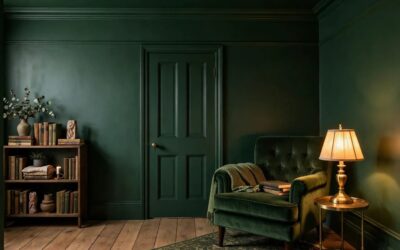
So if you love the dark green wall, paint the dark green wall. If you want wallpaper with enormous birds on it, get the birds. If you do not host formal dinner parties but would use that dining room every day as a painting studio, reading room or place to sew, perhaps it should become the room you actually need rather than a museum exhibit dedicated to a lifestyle you do not have.
A house can be an investment and still be the place where your life happens. Those two ideas do not have to be enemies.
We’re making room for actual life again
One of my favorite parts of the current trend toward warmer homes is that people are creating areas for things other than television. Reading corners, hobby rooms, craft tables, music spaces and little places to sit and talk are appearing again as people look for ways to spend time at home that do not begin and end with a screen.
That idea feels especially appealing because somewhere along the way we became obsessed with making every square foot productive. We turned spare rooms into offices, corners into workstations and dining tables into command centers for laptops, chargers, bills and schedules. Even our homes started feeling like extensions of work.
I would like a little territory back for useless pleasure. Give me a painting table near a window, a comfortable chair and a stack of books. Give me somewhere to make something badly simply because I enjoy making it. Not everything we do needs to become a side hustle, an achievement, a productivity system or content for social media. Some things are allowed to exist because they make an ordinary Tuesday afternoon nicer.
Perhaps that is what sits underneath all of these decorating trends. It isn’t really about brown paint, vintage furniture or whatever we are calling cozy this week. We are tired, and we want our homes to take care of us a little.
Cozy does not mean buying 47 new things
This, however, is where the trend machine usually gets sneaky. First it tells us minimalism is over, and then immediately tries to sell us three thousand dollars’ worth of merchandise so we can achieve the appearance of having lovingly collected things over thirty years.
Please don’t.
The funny thing about the collected-home look is that most of us already own the things required to create it. They are simply packed away in cupboards, closets and garages because at some point we decided they weren’t current enough. Before buying anything, look at what you already have. Bring back the old wooden bowl. Put your books where you can see them. Frame the photograph that makes you happy. Move the lamp from the room nobody uses into the room everybody does.
Drag the forgotten chair out of the bedroom corner, use the good blanket instead of saving it and hang your own artwork rather than waiting until you can afford something you think is more impressive. Put the odd little object you bought on a trip fifteen years ago on the shelf instead of buying another mass-produced object whose sole purpose is apparently to “style” a shelf.
If you do want something new, this is exactly the sort of decorating that makes thrift shops, flea markets, estate sales and Facebook Marketplace far more interesting than buying an entire coordinated collection. The point is personality, and personality is rather difficult to order in a six-piece set.
Imperfect is not the same thing as chaotic
Now, before anyone looks at the chair in her bedroom currently supporting nine pairs of jeans and announces that WildSassy has officially declared her an interior-design visionary, I should clarify that a lived-in home and a home requiring emergency services to locate the dining table are not quite the same thing.
Cozy still needs some breathing room. You want layers, not landslide.
For me, the difference is whether the things in a room are contributing something. Do they add beauty, usefulness, comfort or memory, or are they simply occupying valuable territory because nobody has made a decision about them since 2009? The chipped bowl that belonged to your mother might deserve its place. Seven charging cables belonging to devices nobody in the household can identify may have completed their service.
The goal isn’t to accumulate more things in the name of coziness. It is to edit out some of the meaningless things so the meaningful ones actually have room to be seen. A collected home is not a storage unit with throw pillows.
I think that’s why this trend feels different
Most decorating trends begin by telling women what is wrong with their homes. Your kitchen is dated, your floor is out, your sofa is the wrong shape, your wall color has expired and apparently your cabinet handles have quietly betrayed you while you were making dinner.
This shift feels a little different because, underneath all the fashionable terminology, it feels more like permission. Keep the battered old table if you love it. Hang the family photograph. Mix the patterns. Display the books you’ve actually read. Choose a paint color because it makes you happy rather than because a designer has declared it the neutral of the year. Make somewhere comfortable enough that your friends stay longer than they intended.
Let your home show evidence that you have hobbies, history, pets and people you care about. Let the dog occasionally destroy the aesthetic because the dog lives there too. Let there be a book left open, a paintbrush drying in a jar or a pair of shoes by the door.
Maybe perfection had a good run, but I am ready for rooms with stories in them. I want scratched tables, soft chairs, crooked picture frames and lamps switched on before it gets completely dark. I want a house where you do not immediately panic if somebody spills a little wine because the furniture has already survived worse and probably has a good story attached to it.
The best compliment anyone can give a home may not be, “It looks like a magazine.” I think it might be the moment when someone settles deeper into the chair, looks around and says, **“I really don’t want to leave yet.”**
And perhaps that is what a beautiful home was supposed to feel like all along.


0 Comments